🧩 Support for many adapters
We support 10+ adapters with documentation for each of them. Adding your
own adapter is also easy, you only need to define 3 methods:
.get(), .set() and .entries().
A library to unify KV-stores. Allows you to write code that works on any KV store, both front-end and backend. Supports substores and intuitive expiration times:
npm install polystore
import kv from "polystore";
import { createClient } from "redis";

const store = kv(createClient());

await store.set("hi", data, { expires: "1h" });
console.log(await store.get("hi"));
// { hello: "world" }
It's a KV store. It has set(), get(),
has(), add(), del()
and more.
Getting started, API, Adapters and custom stores fully documented for you.
1600+ tests, Typescript and JSDocs for the best experience using the library.
Write the TTL as "100s", "1week",
"1h" and forget time-related bugs.
At just 4kb (min+gzip), the impact on your app loading time is minimal.
Use it with React, Angular, Plain JS, Node.js, Bun, Tauri, Electron, etc.
We support 10+ adapters with documentation for each of them. Adding your
own adapter is also easy, you only need to define 3 methods:
.get(), .set() and .entries().
import kv from "polystore";

const store1 = kv(new Map());
const store2 = kv(localStorage);
const store3 = kv(redisClient);
const store4 = kv("cookie");
const store5 = kv("file:///users/me/kv.json");
const store6 = kv(yourOwnStore);
A set of high-performance item operations with
.add(), .set(), .get(),
.has() or .del(). We also provide group
operations to manage your data easily.
import kv from "polystore";
const store = kv(new Map());

const key1 = await store.add("value1");
const key2 = await store.set("key2", "value2");
const val1 = await store.get("key1");
const has1 = await store.has("key1");
const key1 = await store.del("key1");
Simply write "1day" with ANY adapter and forget about
calculating TTL, Unix time, seconds vs milliseconds bugs, etc.
await store.get("key");  // null

await store.set("key", "hi", "1second");
await store.get("key");  // "hi"

await sleep(2000);

await store.get("key");  // null
Create a new substore with .prefix(), then you can ignore
anything related to the prefix and treat it as if it was a brand new
store.
const session = store.prefix("session:");
session.set("key1", "value1");

console.log(await session.all());
// { "key1": "value1" }

console.log(await store.all());
// { "session:key1": "value1" }
Iterate asynchronously straight on the store! It will return a pair of
[key, value] for each of the entries. You can also use it
on a substore as well.
for await (const [key, value] of store) {
  console.log(key, value);
}

const session = store.prefix('session:');
for await (const [key, value] of session) {
  console.log(key, value);
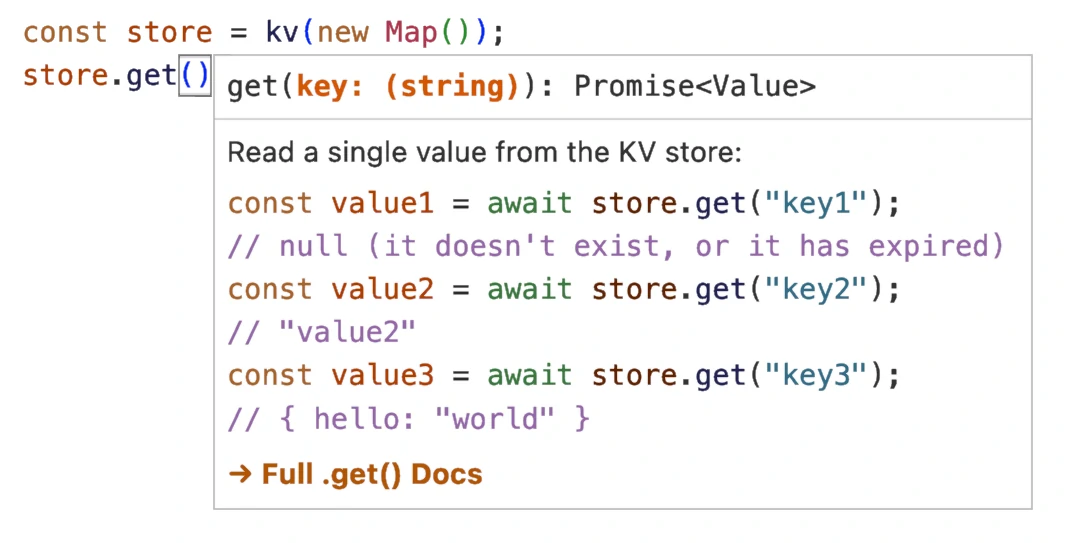
}Added jsdocs so the expected parameters and return value will be clearly defined in your IDE/Code Editor.
We added the description, a representative example and even a link for more information for every one of the methods available! We want you to have the best development experience possible with Polystore!